Key takeaways
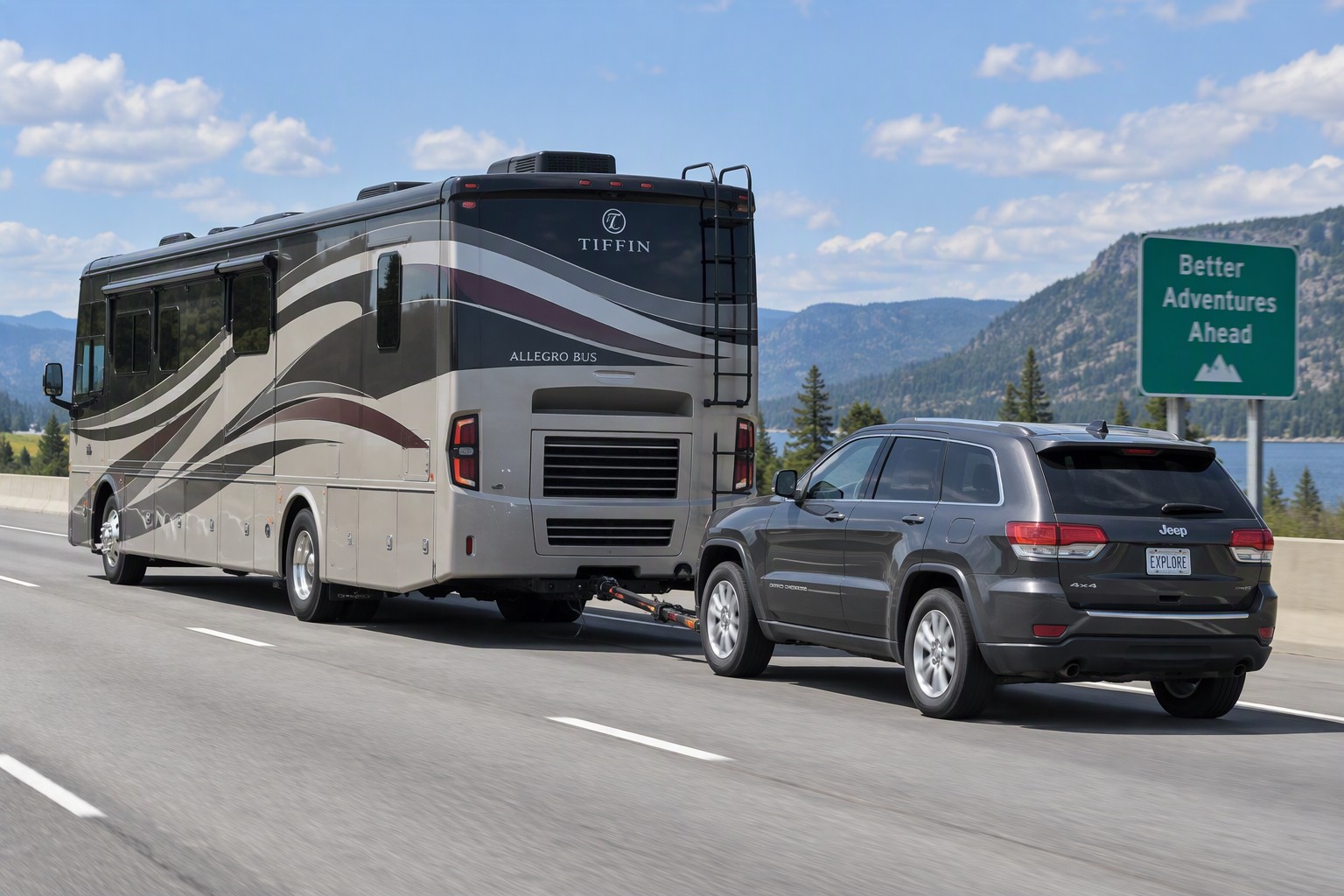
- Flat towing = all four wheels of the towed vehicle on the road.
- You need a tow bar, base plate, safety cables, lighting, and supplemental brakes.
- Only some vehicles are approved for it. Check the owner's manual first.
Flat towing in plain terms
With flat towing, a tow bar connects the back of your motorhome to the front of the vehicle you are towing. The towed vehicle rolls on its own four tires, which is why the method is also called four-down or four wheels down towing. The towed vehicle is commonly called the dinghy or the toad.
The idea is borrowed from boating, where a small boat trails behind a larger one. Once you reach camp, you unhook the dinghy and use it for groceries, sightseeing, and errands without breaking down your campsite in the motorhome.
Why RVers choose flat towing
- Convenience: hooking up and unhooking is usually quicker than loading a vehicle onto a trailer or dolly.
- Less to store: there is no trailer or dolly to park at home or at the campground.
- Freedom at the destination: you keep the motorhome parked and still have a regular vehicle to drive.
- Simple storage of the hardware: many tow bars fold up and stay with the motorhome.
What it takes to flat tow
A safe flat tow setup has five main parts, covered in detail in our flat towing equipment checklist:
- A tow bar rated for the weight you will pull.
- A vehicle-specific base plate bolted to the towed vehicle.
- Safety cables as a backup connection.
- Towed vehicle lighting and wiring.
- A supplemental braking system.
What flat towing is not
Flat towing is not possible with every vehicle. Many cars cannot be towed with all four wheels down without transmission or drivetrain damage, so the vehicle manufacturer's instructions decide the question. See which vehicles can be flat towed.
It is also a method for motorhomes towing a separate vehicle. Travel trailers and fifth wheels are towed in different ways with different equipment. And a flat-towed vehicle generally cannot be backed up while connected, so plan your routes and fuel stops accordingly.
Is flat towing right for you?
Flat towing suits RVers who want fast hookups and plan to travel with a vehicle that the manufacturer approves for four-down towing. If your vehicle is not approved, a tow dolly or car trailer may be the better fit.
Frequently asked questions
Is flat towing the same as dinghy towing?
Yes. Flat towing, dinghy towing, and four-down towing all describe towing a vehicle behind a motorhome with all four wheels on the ground.
Can any car be flat towed?
No. Whether a vehicle can be flat towed depends on its transmission and drivetrain. Always check the recreational towing section of the owner's manual.
Can I back up while flat towing?
You should avoid it. Reversing with a tow bar attached can bind or bend the equipment and damage the towed vehicle. Unhook first, or plan pull-through routes.
This page is general information. Always follow your vehicle owner's manual, equipment instructions, and the laws of the states and provinces you travel through.